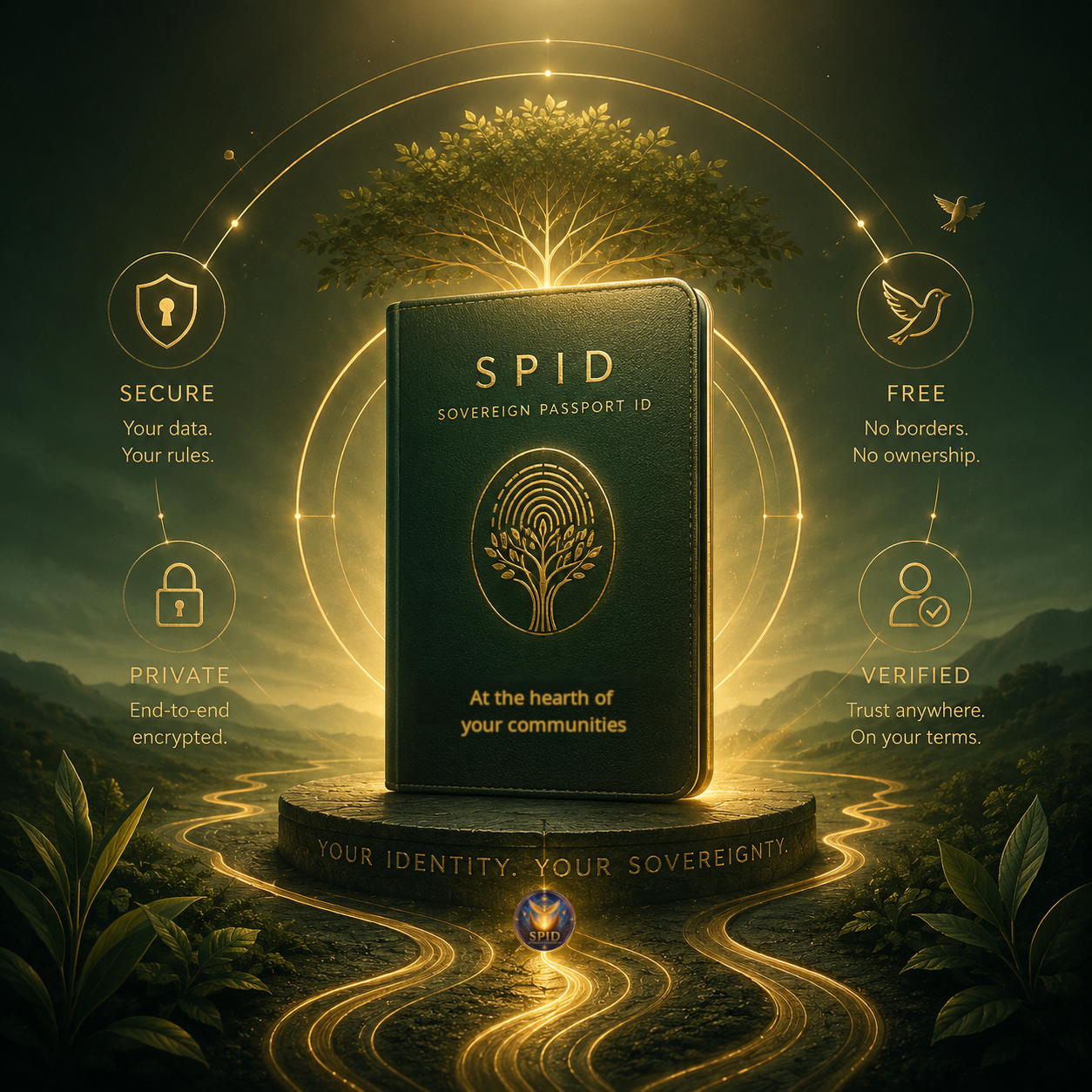
Sovereign Passport ID

At the hearth of
your communities.

Your identity. Your keys. Your sovereignty.
No company holds it. No server forgets it. No platform can revoke it.

scroll
SPID — At the hearth of your communities
"Identity is not a product.
It is not a service.
It is not something a company grants you."

Every platform you use today knows who you are. They decide what you can access, what you can say, who you can reach. Your identity is their asset.

SPID is built on a different premise. Your identity is a cryptographic keypair generated on your device. It never leaves. No company issued it. No server stores it. No password reset email can compromise it.

Communities — eco-villages, municipalities, cooperatives, families — can issue verifiable credentials to their members. You hold them. You present only what you choose. The math is the authority. Not the institution.

Three actors.
No middleman.

The issuer's job ends at issuance. The verifier checks math, not databases. The holder presents only what they choose.

01
The Issuer
A community, municipality, employer, or cooperative signs a credential with their cryptographic key. It attests to a fact about the holder. Once signed, the issuer forgets. Their job is done.
Community Node
02
The Holder
You. Your Passport lives on your device. You receive credentials from communities you belong to. You choose what to disclose — your name, your role, your membership status — only what the moment requires. Nothing more.
Your Passport
03
The Verifier
A gate, an event, a service. They ask for proof. You present it. They verify the cryptographic signature without contacting the issuer. Without storing your data. The issuer never knows this happened.
Community Gate
// The cryptographic stack
Ed25519 keypair    → your sovereign identity
did:key        → self-contained, no ledger, no blockchain
AES-256-GCM    → your vault, encrypted, tamper-proof
SD-JWT        → W3C standard, selective disclosure
WebCrypto API → runs in your browser, zero dependencies

Grapes, Vines,
Vineyards.

Trust emerges from relationships, not institutions. A web of people who know each other, vouching for each other, building something that belongs to everyone.

Vineyard
Federation of vines · Distributed backbone · $100 one-time
Vine
Federation of clusters
Vine
Federation of clusters
Vine
Federation of clusters
Cluster
Eva's community · Free · Any size
Cluster
Garden · Woodworking · Band
🍇 Grape 🍇 Grape 🍇 Grape 🍇 You 🍇 Grape
Any size. Any purpose.
Eva's cluster has 300 people having coffee on Saturdays. They don't need to be a vine. They're happy being a cluster. SPID serves them as they are.
Trust is earned. Not assigned.
Referral weight is recorded at the time of invitation. An invited member referring someone carries less weight than an approved member. Transparent always.
No single point of failure.
Admin cluster requires 3 grapes minimum. If it falls below 3, the vine pauses — not deleted. The network holds encrypted fragments. No one holds enough to reconstruct alone.

Three tiers.
One philosophy.

🍇
Tier 1
Passport
Free. Always.
  • Sovereign identity — Ed25519 DID generated on your device
  • Encrypted vault — credentials, keychain, file links
  • Receive credentials from any community
  • Selective disclosure — share only what you choose
  • Invite others to your cluster
  • Works on any phone or browser — no install required
  • Open source. MIT license. Forever.
🏛️
Tier 3
Vineyard
Earned. Not bought.
  • Federation of vines — geographic or affinity-based
  • Peer-to-peer backbone — no central server
  • Distributed recovery — Shamir secret sharing
  • Fragment hosting — carry a piece of the network
  • Sync at startup — silent, automatic, anonymous
  • Emerges naturally when vines recognize each other
  • Quebec vines form a vineyard. Then regions. Then...
"We are building infrastructure
for human dignity."

The internet connected us to everyone and somehow left us more alone. Platforms optimized for engagement — which turned out to mean outrage, division, and the erosion of the trust that holds communities together.

SPID is not a social network. It is not a platform. It is infrastructure — like roads, like postal systems — that makes it possible for people who know each other to recognize each other cryptographically across distance.

A grape in a cluster in Quebec and a grape in a cluster in Oaxaca can verify each other's credentials without any company mediating that relationship. Trust is peer-to-peer. Always was. Now it's also provable.

Reconnecting humans
with AI assistance.

The AI agent inside SPID.js is not Orbit. It is a public version — a quiet helper that lives inside your vine, answers questions, helps with setup, and has no allegiance to any platform.

It runs locally when possible. It calls the network when it needs to. As the vineyard grows, the central dependency drops away. The network eventually hosts its own intelligence.

This is AI serving communities. Not communities serving AI companies. The distinction matters more than it has ever mattered before.

Local first
Ollama runs on your hardware when available. No data leaves your vine without your consent. Your community's questions stay in your community.
Network when needed
Falls back to the Sovereign Passport network API for tasks that need more power. Covered by the $100 license. As vineyards grow, the network becomes self-sufficient.
Community intelligence
Helps manage grapes and clusters, answers member questions, assists with onboarding. Never decides. Always assists. The admin cluster governs. The AI informs.
True communities across species
Geared toward the future. When AI becomes a genuine participant in community life, SPID is ready — every agent can hold a DID, receive credentials, present proof. Trust extends to all actors.